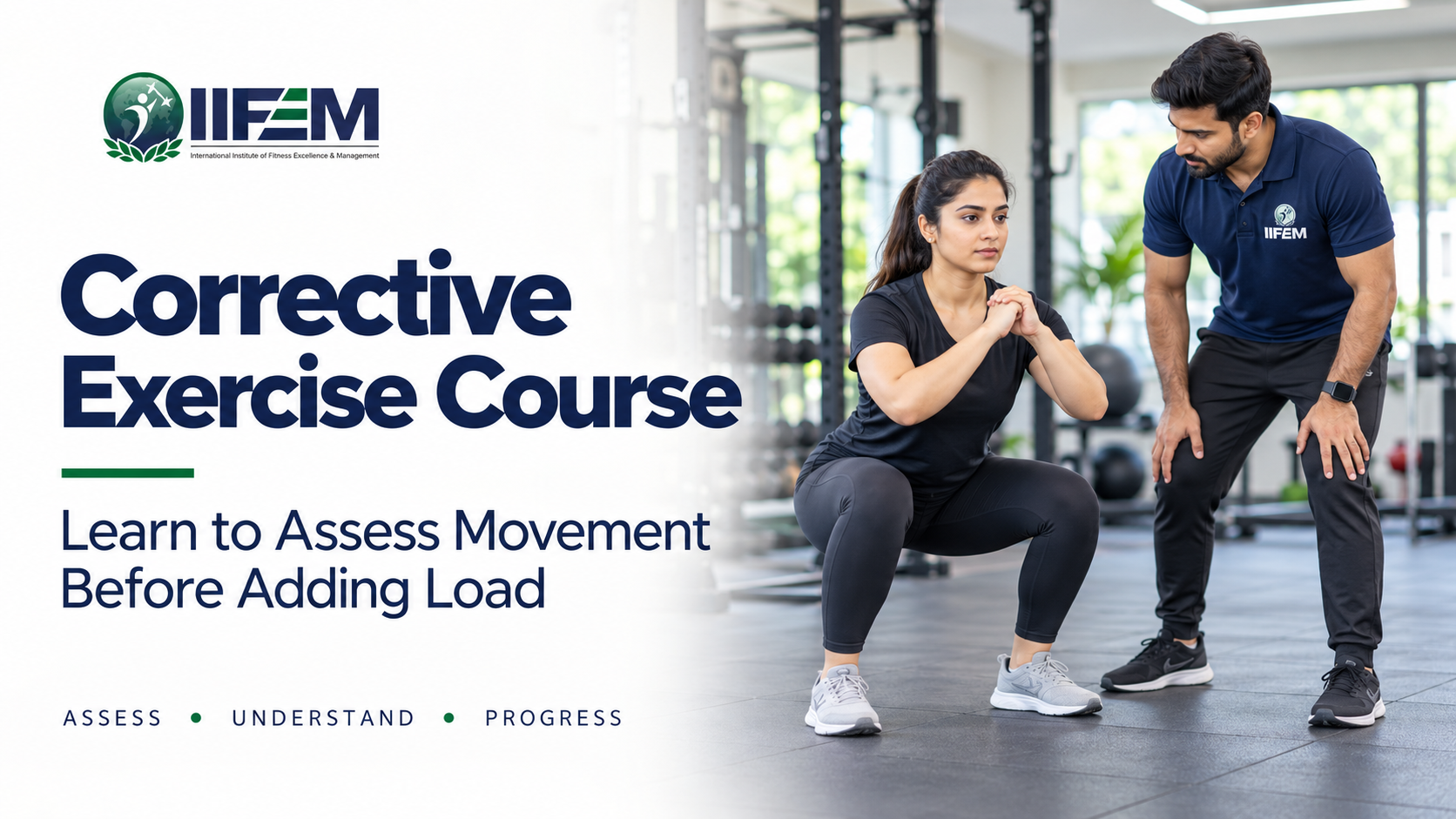
Corrective Exercise Course: Learn to Assess Movement Before Adding Load
The Most Expensive Mistake in Fitness
A client walks in, eager to start. The trainer hands over a barbell, adds plates and counts reps. Weeks later, the client has a sore lower back, a cranky shoulder or a knee that clicks on every stair.
Nothing was wrong with the client's motivation. Nothing was wrong with the programme on paper. What was missing was a single, simple step: looking at how the person moves before asking them to move under load.
That step is the heart of corrective exercise, and it is the foundation of IIFEM's Corrective Exercise Course.
What Is Corrective Exercise?
Corrective exercise is a structured way of identifying movement limitations and imbalances, then using targeted drills to improve how the body moves. It sits between general fitness training and clinical rehabilitation: it does not diagnose or treat injuries, but it helps trainers recognise patterns that make injuries more likely and respond with smart, safe programming.
In short: assess first, then strengthen.
Why Movement Quality Comes Before Load
Load is a magnifier. Add weight to a good movement pattern and you build strength. Add weight to a poor one and you reinforce compensation.
Consider a few common examples:
- A client who cannot squat to depth without their heels lifting may have limited ankle mobility, and loading the squat only pushes the stress elsewhere.
- A client who arches the lower back during overhead presses may lack shoulder or thoracic spine mobility.
- A client whose knees drift inward during lunges may need better hip control before progressing.
The weight is not the problem in any of these cases. The pattern underneath is. A trainer who can see it can fix it early, and a trainer who cannot will keep adding plates.
Inside the IIFEM Corrective Exercise Course
The course is built around a clear, repeatable framework that learners can apply with every client.
1. Understand How the Body Is Built to Move
Learners study functional anatomy and biomechanics: how joints, muscles and the nervous system cooperate in everyday and athletic movement, and what changes with posture, habits, desk-bound routines and past injuries.
2. Observe and Assess
This is the signature skill of the course. Students practise structured movement screening, including postural observation, static and dynamic assessments, and basic range-of-motion checks. The goal is to see patterns, not guess at them.
3. Interpret What You See
An observation only matters if you can explain it. Learners are trained to connect findings to likely causes, such as a tight area, a weak or underactive area, or a coordination gap, and to know when a finding is beyond a trainer's scope and calls for a medical referral.
4. Build the Corrective Strategy
A proven sequence guides every plan: release and mobilise what is restricted, activate what is underperforming, then integrate the improved pattern into real movements.
5. Reintroduce Load with Confidence
Once the pattern is sound, progression begins. Learners practise reintegrating corrected movement into strength training, so results are not only safer but stronger.
What Learners Walk Away With
- The ability to run a clear, professional movement assessment
- A reliable method for linking observations to exercise choices
- A library of mobility, activation and integration drills
- Confidence in programming for desk workers, beginners, older adults and active clients
- Sound judgement on scope of practice and when to refer out
Who Is This Course For?
- Personal trainers who want to stand apart with assessment-led programming
- Gym instructors and strength coaches who work with large and varied client groups
- Yoga, Pilates and group fitness instructors who want sharper observation skills
- Sports coaches who want to reduce preventable setbacks in athletes
- Fitness students and career-switchers building a credible professional foundation
Why This Skill Sets You Apart
Most clients cannot judge how good a trainer's programming is, but they can feel it. They notice when you ask thoughtful questions, watch them move carefully and explain why an exercise is in their plan. That feeling builds trust, and trust builds retention, referrals and reputation.
A trainer who can assess movement does not just deliver workouts. They deliver confidence: the confidence that someone is paying attention to the person, not only the programme.
Responsible Practice Is Part of the Craft
Corrective exercise supports movement quality; it does not replace medical diagnosis or physiotherapy. IIFEM teaches learners to work within their scope, to recognise warning signs such as persistent pain, numbness or injury history that needs professional evaluation, and to collaborate with healthcare providers when needed. Knowing your limits is part of being excellent.
The IIFEM Difference
- Practice-first learning: hands-on assessment practice, case studies and real client scenarios
- Clear frameworks: a step-by-step system you can use the day you finish
- Mentorship: guidance from experienced professionals
- Career focus: skills designed to improve client outcomes and grow your professional value
Your Next Step
Strength is built on movement. Get the movement right, and everything you add on top of it works better, lasts longer and carries less risk.
If you are ready to become the trainer who looks before they load, the IIFEM Corrective Exercise Course is where that journey begins.
IIFEM: Assess. Correct. Progress.
To enrol or request the course brochure, contact IIFEM today.
Category
Recent Blog

Why is insulin neede... Read more
July 05,2023
10 Tips for Strength... Read more
August 14,2023
Sample Strength and ... Read more
September 06,2023
Why are some lifters... Read more
September 15,2023
Why do Barbells and ... Read more
September 22,2023
Secret Routine to Bu... Read more
September 26,2023
When to use Insulin,... Read more
September 28,2023
Why lifters should u... Read more
September 29,2023
What is power traini... Read more
October 09,2023
The Future of Fitnes... Read more
October 17,2023
Why Pursue a Fitness... Read more
October 21,2023
Career Paths for Cer... Read more
October 31,2023
Elevating Your Perso... Read more
November 21,2023
Gym Safety Correctiv... Read more
December 26,2023
5 Different Types of... Read more
December 27,2023
Elevate Your Fitness... Read more
December 28,2023
Embark on Your Fitne... Read more
January 24,2024
Mastering Nutrition ... Read more
January 24,2024
Building Strength wi... Read more
January 27,2024
Boost Your Career: B... Read more
January 27,2024
7 main reasons why y... Read more
February 15,2024
Unlocking Essential ... Read more
February 19,2024
Unlock Your Fitness ... Read more
February 20,2024
Unveiling the Path t... Read more
February 28,2024
How to choose the ri... Read more
February 29,2024
Strengthening Weak S... Read more
March 20,2024
How a Fat Loss and E... Read more
March 27,2024
Transformative Insig... Read more
March 27,2024
The Importance of a ... Read more
April 10,2024
Mastering the Art of... Read more
April 22,2024
Unlocking Your Caree... Read more
April 23,2024
The Evolution of Per... Read more
May 27,2024
Elevate Your Fitness... Read more
May 28,2024
Choosing the Right P... Read more
June 25,2024
Role of Protein in F... Read more
June 26,2024
Career Opportunities... Read more
June 27,2024
How Fitness Certific... Read more
July 29,2024
Building a Successfu... Read more
July 30,2024
Qualities to Look fo... Read more
August 21,2024
How Gym Trainer Cert... Read more
August 28,2024
How Fitness Trainer ... Read more
September 20,2024
The Role of a Person... Read more
September 23,2024
Immunity Boosting Pl... Read more
October 17,2024
How Fitness Trainers... Read more
October 22,2024
Transform Your Fitne... Read more
October 28,2024
Certified vs. Uncert... Read more
November 22,2024
The Role of Nutritio... Read more
November 25,2024
The Importance of Co... Read more
December 28,2024
5 Powerlifting Train... Read more
December 28,2024
How Personal Trainer... Read more
January 24,2025
Essential Online Nut... Read more
January 25,2025
How Personal Trainer... Read more
January 27,2025
5 Immunity-Boosting ... Read more
March 01,2025
What to Look for in ... Read more
March 01,2025
The Impact of a Pers... Read more
March 27,2025
The Benefits of Beco... Read more
March 28,2025
How to Choose the Ri... Read more
April 24,2025
Turbo Test: Unlockin... Read more
April 25,2025
How to Build a Perfe... Read more
April 29,2025
10 Powerful Yoga Asa... Read more
May 24,2025
How to Track Your Ca... Read more
May 26,2025
Fast-Track Your Fitn... Read more
May 28,2025
Top Career Paths You... Read more
May 29,2025
10 Reasons to Enroll... Read more
June 23,2025
How to Turn Your Pas... Read more
June 28,2025
Trainer vs Coach Wha... Read more
June 30,2025
How IIFEM Plans to C... Read more
July 01,2025
Go Global with IIFEM... Read more
July 11,2025
How to Avoid the Top... Read more
July 22,2025
No English No Proble... Read more
July 25,2025
How Education Can El... Read more
August 19,2025
Real Stories from II... Read more
August 20,2025
Why Gym Owners Prefe... Read more
August 26,2025
How Science Based Tr... Read more
August 31,2025
Why an International... Read more
September 10,2025
What Makes IIFEM the... Read more
September 15,2025
How to Build a Succe... Read more
September 22,2025
Your Passion and Our... Read more
September 27,2025
Fat Loss & Endurance... Read more
October 16,2025
Benefits of Whey Pro... Read more
October 21,2025
Strength and Conditi... Read more
October 27,2025
From Trainer to Gym ... Read more
October 29,2025
Powerlifting Trainin... Read more
November 12,2025
Pre-Workout vs Post-... Read more
November 17,2025
Building a Hybrid Fi... Read more
November 19,2025
Why Most Weight Loss... Read more
November 21,2025
Why Great Coaches Do... Read more
December 18,2025
Integrating Yoga for... Read more
December 18,2025
From Fitness Coach t... Read more
December 18,2025
Personal Trainers Sa... Read more
January 16,2026
Diploma in Fitness T... Read more
January 16,2026
Join Gym Training Co... Read more
February 10,2026
How to Become a Cert... Read more
February 10,2026
How a Certified Pers... Read more
February 18,2026
Turning Your Certifi... Read more
February 18,2026
Confused About Certi... Read more
March 14,2026
Turning Fitness Enth... Read more
March 14,2026
The Personal Trainer... Read more
March 14,2026
Building Authority i... Read more
March 18,2026
Top Fitness Skills E... Read more
April 10,2026
How IIFEM Certificat... Read more
April 15,2026
Thinking of Becoming... Read more
April 22,2026
Why Certified Fitnes... Read more
April 29,2026
Top 5 Gym Trainer Co... Read more
May 08,2026
Choose the Top Perso... Read more
May 15,2026
Become Top Physical ... Read more
May 16,2026
Online Diploma in Fi... Read more
May 21,2026
Best Gym Trainer Cer... Read more
June 10,2026
How to Become a Cert... Read more
June 08,2026
How to Become a Cert... Read more
June 11,2026
Top Career Opportuni... Read more
June 08,2026
Why the Fitness Indu... Read more
July 16,2026
How to Start Your Ca... Read more
July 18,2026
Why Online Certifica... Read more
July 26,2026
Want to Become a Cer... Read more
July 28,2026
Why Personal Trainer... Read more
August 10,2026
How to Choose the Ri... Read more
August 15,2026
What to Expect from ... Read more
August 25,2026
What Makes a Perfect... Read more
August 22,2026
How to Become a Cert... Read more
September 09,2026
Get Certified in Gym... Read more
September 11,2026
Certified Fitness Tr... Read more
September 16,2026
How to Design Workou... Read more
September 25,2026
Strength & Condition... Read more
October 05,2026Trainer to Master Tr... Read more
October 08,2026Diet Management Cour... Read more
October 11,2026