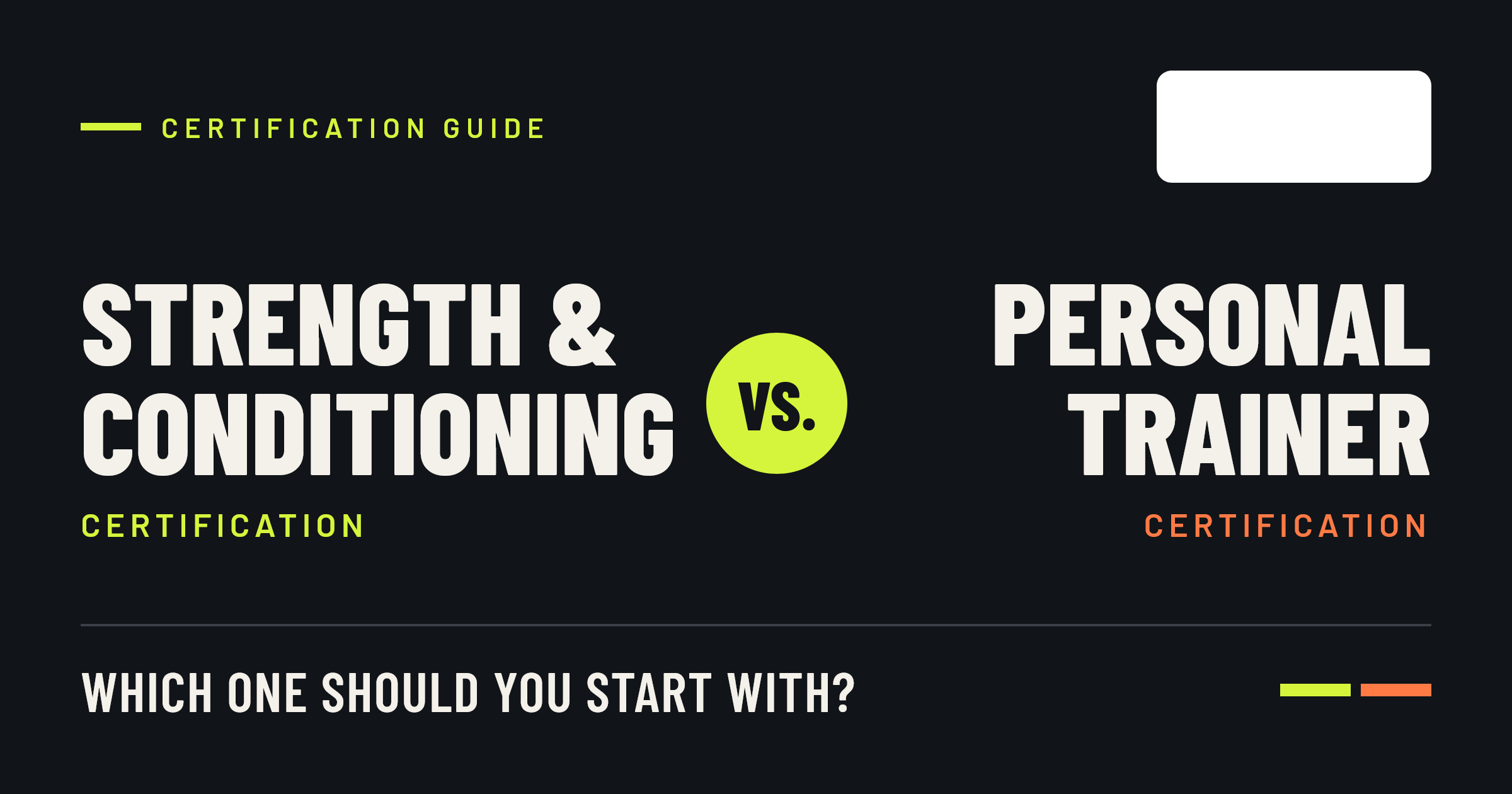
Strength & Conditioning Certification vs. Personal Trainer Certification: Which One Should You Start With?
Most people who ask this question are standing at the same fork in the road. They love training, they want to turn that into a living, and two certifications keep showing up in every search result. Both sound right. Both promise a career.
Here is the honest answer: they are not rivals. They prepare you for two different jobs, and the right first step depends on who you picture yourself coaching a year from now.
The short version
A Personal Trainer certification prepares you to work with individuals, usually everyday gym members, and help them reach goals like fat loss, muscle gain, better health or simply more confidence.
A Strength & Conditioning certification prepares you to improve physical performance: strength, power, speed, endurance and the ability to repeat them under pressure. It is the language of athletes, but it is useful far beyond sport.
One is built around the person. The other is built around the performance.
What a Personal Trainer certification really prepares you for
Think of a typical first session. A new client walks in and says they want to lose weight, their lower back is stiff, and they have a family function in four months. You are expected to listen, assess, plan, explain, adjust and, most importantly, keep them coming back.
That is the real skill set of a personal trainer: breadth and people handling. You need working knowledge of programming, exercise technique, basic nutrition conversations, goal setting and habit building. You also need patience, because most clients are not training for a competition. They are training around busy lives.
If you want to work in a gym, build a client base or eventually run your own coaching business, this is where most trainers begin.
What Strength & Conditioning prepares you for
Strength & Conditioning goes deeper into one question: how does the body adapt to training, and how do we use that to make someone measurably better?
That means understanding how load, volume and recovery interact, how to progress strength over months instead of weeks, how power and speed are trained, how energy systems work, and how to plan a training year so someone peaks when it matters. A cricketer, a sprinter, a wrestler and a weekend marathon runner all need different answers to that question.
The focus is less on "what workout should this person do today" and more on "what should the next twelve weeks look like, and why."
Side by side
|
|
Personal Trainer |
Strength & Conditioning |
|---|---|---|
|
Main focus |
Overall client goals and health |
Physical performance and adaptation |
|
Typical clients |
General gym members, beginners, lifestyle goals |
Athletes, sports players, performance-minded lifters |
|
Core skill |
Assessment, coaching, motivation, retention |
Programming, progression, periodization |
|
Where you may work |
Gyms, studios, online coaching, home training |
Academies, teams, performance centres, advanced gym coaching |
|
Best for |
People who enjoy working with a wide range of clients |
People drawn to sport, strength and measurable performance |
Where the two overlap
The lines are blurrier in real life than on a comparison chart. A good personal trainer uses strength and conditioning principles every day: progressive overload, sensible rest, planned variation. A good strength coach still needs to communicate, motivate and adapt to the person in front of them.
This overlap is why the decision is not permanent. Choosing one does not close the door on the other.
How to choose
Start with a Personal Trainer certification if:
- You want to start earning in a gym or as an independent trainer as soon as possible
- You enjoy variety and want to help people with very different goals
- You are still discovering which part of fitness you like most
Start with Strength & Conditioning if:
- You already train seriously and want to coach athletes or performance-focused clients
- You are fascinated by programming, progression and how training is structured over time
- You want to stand out in a market full of general trainers
Three mistakes people make
1. Choosing by how impressive the name sounds. The better certification is the one that matches the clients you actually want to work with.
2. Assuming Strength & Conditioning is only for elite athletes. Many gym-goers want to get stronger, move better and perform well. A coach who can program that properly is valuable.
3. Treating Personal Training as the "basic" option. Keeping a real person consistent for six months is harder than writing a clever program. Retention is a skill, and it is the one that builds a client base.
The path many trainers end up taking
A common route is to begin with a personal trainer certification, build real client experience, then add Strength & Conditioning to go deeper and raise the quality of programming. Coaches who already work with athletes often do it the other way around.
IIFEM offers both as separate certifications, along with related courses such as Periodization and Powerlifting Training Specialist, so you can build in stages instead of committing to everything at once. Combination packages are also available if you already know you want more than one, and the courses are delivered through recorded lectures and the IIFEM app, so you can study around your work schedule.
One question to settle it
Forget the course names for a moment and ask yourself: who do I want to be training twelve months from now?
If the answer is a mix of everyday people with different goals, start with Personal Training. If it is athletes and strength-driven clients, start with Strength & Conditioning. Either way, you are not choosing a final career. You are choosing a strong first step.
Ready to explore the options? Browse the Personal Trainer and Strength & Conditioning programs on the IIFEM courses page, or reach out to the team for help choosing the right starting point.
Category
Recent Blog

Why is insulin neede... Read more
July 05,2023
10 Tips for Strength... Read more
August 14,2023
Sample Strength and ... Read more
September 06,2023
Why are some lifters... Read more
September 15,2023
Why do Barbells and ... Read more
September 22,2023
Secret Routine to Bu... Read more
September 26,2023
When to use Insulin,... Read more
September 28,2023
Why lifters should u... Read more
September 29,2023
What is power traini... Read more
October 09,2023
The Future of Fitnes... Read more
October 17,2023
Why Pursue a Fitness... Read more
October 21,2023
Career Paths for Cer... Read more
October 31,2023
Elevating Your Perso... Read more
November 21,2023
Gym Safety Correctiv... Read more
December 26,2023
5 Different Types of... Read more
December 27,2023
Elevate Your Fitness... Read more
December 28,2023
Embark on Your Fitne... Read more
January 24,2024
Mastering Nutrition ... Read more
January 24,2024
Building Strength wi... Read more
January 27,2024
Boost Your Career: B... Read more
January 27,2024
7 main reasons why y... Read more
February 15,2024
Unlocking Essential ... Read more
February 19,2024
Unlock Your Fitness ... Read more
February 20,2024
Unveiling the Path t... Read more
February 28,2024
How to choose the ri... Read more
February 29,2024
Strengthening Weak S... Read more
March 20,2024
How a Fat Loss and E... Read more
March 27,2024
Transformative Insig... Read more
March 27,2024
The Importance of a ... Read more
April 10,2024
Mastering the Art of... Read more
April 22,2024
Unlocking Your Caree... Read more
April 23,2024
The Evolution of Per... Read more
May 27,2024
Elevate Your Fitness... Read more
May 28,2024
Choosing the Right P... Read more
June 25,2024
Role of Protein in F... Read more
June 26,2024
Career Opportunities... Read more
June 27,2024
How Fitness Certific... Read more
July 29,2024
Building a Successfu... Read more
July 30,2024
Qualities to Look fo... Read more
August 21,2024
How Gym Trainer Cert... Read more
August 28,2024
How Fitness Trainer ... Read more
September 20,2024
The Role of a Person... Read more
September 23,2024
Immunity Boosting Pl... Read more
October 17,2024
How Fitness Trainers... Read more
October 22,2024
Transform Your Fitne... Read more
October 28,2024
Certified vs. Uncert... Read more
November 22,2024
The Role of Nutritio... Read more
November 25,2024
The Importance of Co... Read more
December 28,2024
5 Powerlifting Train... Read more
December 28,2024
How Personal Trainer... Read more
January 24,2025
Essential Online Nut... Read more
January 25,2025
How Personal Trainer... Read more
January 27,2025
5 Immunity-Boosting ... Read more
March 01,2025
What to Look for in ... Read more
March 01,2025
The Impact of a Pers... Read more
March 27,2025
The Benefits of Beco... Read more
March 28,2025
How to Choose the Ri... Read more
April 24,2025
Turbo Test: Unlockin... Read more
April 25,2025
How to Build a Perfe... Read more
April 29,2025
10 Powerful Yoga Asa... Read more
May 24,2025
How to Track Your Ca... Read more
May 26,2025
Fast-Track Your Fitn... Read more
May 28,2025
Top Career Paths You... Read more
May 29,2025
10 Reasons to Enroll... Read more
June 23,2025
How to Turn Your Pas... Read more
June 28,2025
Trainer vs Coach Wha... Read more
June 30,2025
How IIFEM Plans to C... Read more
July 01,2025
Go Global with IIFEM... Read more
July 11,2025
How to Avoid the Top... Read more
July 22,2025
No English No Proble... Read more
July 25,2025
How Education Can El... Read more
August 19,2025
Real Stories from II... Read more
August 20,2025
Why Gym Owners Prefe... Read more
August 26,2025
How Science Based Tr... Read more
August 31,2025
Why an International... Read more
September 10,2025
What Makes IIFEM the... Read more
September 15,2025
How to Build a Succe... Read more
September 22,2025
Your Passion and Our... Read more
September 27,2025
Fat Loss & Endurance... Read more
October 16,2025
Benefits of Whey Pro... Read more
October 21,2025
Strength and Conditi... Read more
October 27,2025
From Trainer to Gym ... Read more
October 29,2025
Powerlifting Trainin... Read more
November 12,2025
Pre-Workout vs Post-... Read more
November 17,2025
Building a Hybrid Fi... Read more
November 19,2025
Why Most Weight Loss... Read more
November 21,2025
Why Great Coaches Do... Read more
December 18,2025
Integrating Yoga for... Read more
December 18,2025
From Fitness Coach t... Read more
December 18,2025
Personal Trainers Sa... Read more
January 16,2026
Diploma in Fitness T... Read more
January 16,2026
Join Gym Training Co... Read more
February 10,2026
How to Become a Cert... Read more
February 10,2026
How a Certified Pers... Read more
February 18,2026
Turning Your Certifi... Read more
February 18,2026
Confused About Certi... Read more
March 14,2026
Turning Fitness Enth... Read more
March 14,2026
The Personal Trainer... Read more
March 14,2026
Building Authority i... Read more
March 18,2026
Top Fitness Skills E... Read more
April 10,2026
How IIFEM Certificat... Read more
April 15,2026
Thinking of Becoming... Read more
April 22,2026
Why Certified Fitnes... Read more
April 29,2026
Top 5 Gym Trainer Co... Read more
May 08,2026
Choose the Top Perso... Read more
May 15,2026
Become Top Physical ... Read more
May 16,2026
Online Diploma in Fi... Read more
May 21,2026
Best Gym Trainer Cer... Read more
June 10,2026
How to Become a Cert... Read more
June 08,2026
How to Become a Cert... Read more
June 11,2026
Top Career Opportuni... Read more
June 08,2026
Why the Fitness Indu... Read more
July 16,2026
How to Start Your Ca... Read more
July 18,2026
Why Online Certifica... Read more
July 26,2026
Want to Become a Cer... Read more
July 28,2026
Why Personal Trainer... Read more
August 10,2026
How to Choose the Ri... Read more
August 15,2026
What to Expect from ... Read more
August 25,2026
What Makes a Perfect... Read more
August 22,2026
How to Become a Cert... Read more
September 09,2026
Get Certified in Gym... Read more
September 11,2026
Certified Fitness Tr... Read more
September 16,2026
How to Design Workou... Read more
September 25,2026Trainer to Master Tr... Read more
October 08,2026Diet Management Cour... Read more
October 11,2026
Corrective Exercise ... Read more
October 15,2026