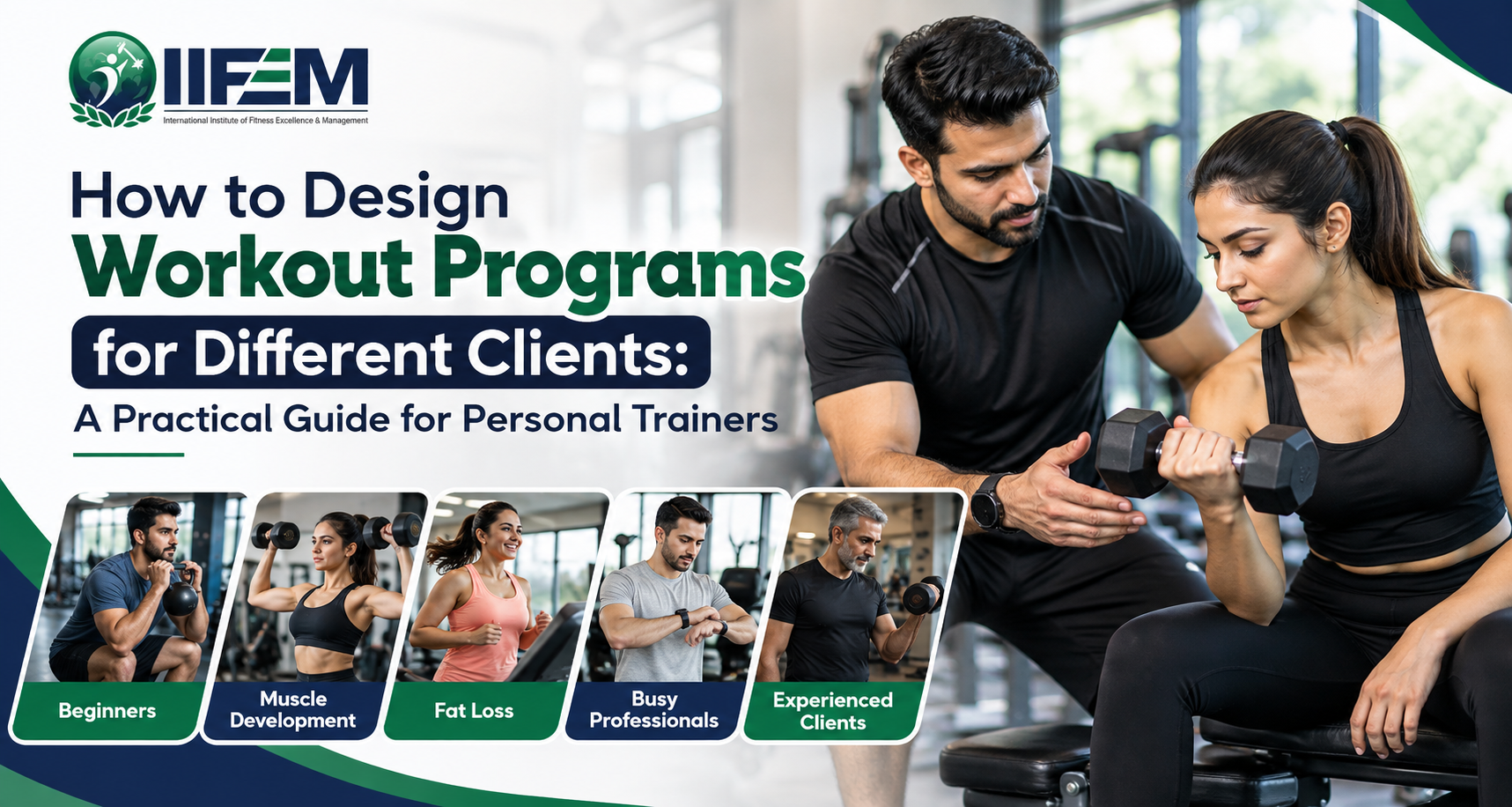
How to Design Workout Programs for Different Clients: A Practical Guide for Personal Trainers
A good workout program is not simply a collection of effective exercises. It is a structured plan built around the person who will actually perform those exercises.
Two clients may walk into a gym with the same goal—fat loss, muscle gain or improved fitness—but that does not mean they should follow the same program. Their training history, movement ability, lifestyle, available time, recovery, confidence and physical capacity can be completely different.
This is where professional personal training goes beyond knowing exercises.
For personal trainers, workout program design is the process of turning a client's goals and assessment information into a realistic training plan that can progress over time. The best programs are not necessarily the most complicated. They are the ones clients can perform safely, consistently and progressively.
Start With the Client, Not the Workout
It can be tempting to begin programming by choosing exercises. In practice, exercise selection should come later.
Before designing a workout, a trainer needs to understand who they are training.
An initial consultation and appropriate pre-exercise screening can help establish important information, including:
-
Primary and secondary fitness goals
-
Previous exercise experience
-
Current activity level
-
Training preferences
-
Available training days and session duration
-
Lifestyle and occupational demands
-
Relevant injury or medical history
-
Movement capabilities and limitations
-
Access to equipment
-
Sleep and recovery habits
This information provides the foundation for the program.
For example, programming four demanding gym sessions each week may look excellent on paper. But if the client can realistically train only twice a week, it is not an effective program for that person.
A program should fit the client rather than forcing the client to fit the program.
Define a Clear and Measurable Goal
"Getting fit" is difficult to program for because it can mean almost anything.
A trainer should work with the client to turn broad intentions into clearer objectives.
A client wanting to "get stronger", for example, may actually want enough lower-body and upper-body strength to improve performance in a particular activity. Another may simply want to feel stronger performing everyday tasks.
Likewise, someone seeking fat loss may also want to improve cardiovascular fitness, maintain muscle and develop a sustainable exercise routine.
Understanding the real objective influences:
Training frequency → exercise selection → volume → intensity → progression → monitoring.
Where appropriate, trainers can establish measurable indicators so progress can be reviewed rather than guessed.
Assess the Client's Starting Point
Goals tell you where the client wants to go. Assessment helps determine where they are starting.
The assessment process should be relevant to the individual rather than a long list of tests performed simply because they are available.
Depending on the client's circumstances and the trainer's professional scope, useful assessment areas may include cardiovascular fitness, movement quality, mobility, muscular strength or endurance and other appropriate fitness measures.
The results help answer an important programming question:
What can this person perform effectively now?
Suppose two people both want to improve lower-body strength. One has trained consistently for several years and demonstrates good movement control. The other is completely new to resistance training.
Their goal may be similar, but their starting programs should not be.
The experienced client may be ready for greater training volume and more demanding exercise variations. The beginner may benefit more from mastering fundamental movement patterns, developing confidence and gradually increasing training demands.
Build Around Movement Patterns
Instead of viewing program design as a catalogue of individual exercises, trainers can think in terms of movement patterns and functions.
Depending on the client and goal, a balanced resistance-training program may incorporate patterns such as:
Squat or knee-dominant movement – for example, squat variations, split squats or leg presses.
Hip-dominant movement – such as appropriate deadlift variations, hip hinges or hip thrusts.
Push movements – including horizontal and vertical pressing variations.
Pull movements – including rows and vertical pulling exercises.
Core and trunk function – selected according to the demands and abilities of the client.
Exercise selection within those categories can then be modified according to experience, mobility, technique, equipment and goals.
The question is therefore not simply, "What is the best exercise?"
A more useful question is:
"What is an appropriate exercise for this client, for this goal, at this stage of training?"
Adjust Training for Different Clients
Personalisation becomes particularly important when clients have very different needs.
The Complete Beginner
A beginner usually does not need an elaborate program.
The initial priority may be developing exercise technique, basic strength, movement confidence and consistency.
A manageable full-body routine performed a few times per week may be more appropriate than a complex body-part split. Exercise variations should allow the trainer to teach good movement while gradually exposing the client to greater training demands.
Progress does not have to mean adding weight every session. Improved technique, greater control, additional repetitions and better tolerance to training are also meaningful forms of progress.
The Client Focused on Muscle Development
For clients seeking muscular development, programming becomes more dependent on factors such as weekly training volume, exercise selection, effort, recovery and progressive overload.
Exercises should allow the target musculature to be trained effectively while matching the individual's structure, technique and experience.
More exercises do not automatically produce better results. Trainers should consider whether additional work is genuinely contributing to the client's goal or merely adding fatigue.
The Fat-Loss Client
Fat-loss programming is often misunderstood as a requirement to make every session exhausting.
Training can instead support fat-loss goals by helping the client maintain or develop physical capacity and lean tissue while increasing overall activity.
Resistance training, suitable cardiovascular work and sustainable activity can all have a place within the plan.
Personal trainers should also recognise professional boundaries. Exercise programming and general healthy-lifestyle education are different from providing nutrition or medical services beyond the trainer's qualifications.
The Busy Professional
For a client with limited time, efficiency becomes an important programming variable.
A well-structured 40-minute session that the client completes consistently can be more valuable than an ambitious 90-minute program that is repeatedly missed.
Trainers may use carefully selected compound movements, sensible exercise sequencing and realistic weekly frequency to maximise the value of the available training time.
This is a good example of why personalisation is about more than physical differences. Lifestyle is part of program design.
The Experienced Client
Advanced clients generally require more than simply adding extra exercises.
Programming may need greater attention to workload distribution, training phases, exercise variation, fatigue and recovery.
Progress can become slower as training experience increases, making accurate record keeping particularly useful.
Changes should have a reason. Constantly replacing exercises for novelty can make it difficult to determine whether the program is actually producing progress.
Understand Volume, Intensity and Frequency
Three variables have a major influence on workout design:
Volume describes the amount of training performed.
Intensity can describe how demanding the training is, including the resistance used relative to a person's capacity.
Frequency refers to how often training—or a particular movement or muscle group—is performed.
These variables interact.
Increasing all of them simultaneously is not automatically better. A significant increase in training volume, for example, may require adjustments elsewhere to keep the overall workload appropriate.
Professional programming therefore involves managing the training stimulus and the client's ability to recover from it.
Progression Should Be Planned, Not Random
A workout program needs somewhere to go.
Progressive overload is often associated only with lifting heavier weights, but progression can occur in several ways depending on the exercise and training objective.
A client may progress by:
-
Increasing resistance
-
Performing additional repetitions
-
Increasing appropriate training volume
-
Improving movement quality or range of motion
-
Performing a more challenging exercise variation
-
Improving work capacity
-
Completing the same work with better control
The appropriate progression depends on the person.
Increasing resistance when technique is deteriorating is not necessarily progress. Sometimes maintaining a load while improving execution is the better coaching decision.
Recovery Belongs in the Program
Training creates a stimulus. Adaptation requires recovery.
Personal trainers should therefore consider the demands clients experience outside the gym.
Poor sleep, demanding work schedules, high levels of physical activity and insufficient recovery between sessions can all affect training performance.
This does not mean trainers need to redesign the entire program every time a client has a difficult day. It means programming should be flexible enough to respond when necessary.
The ability to adjust a session intelligently is an important coaching skill.
Track What Actually Matters
Without monitoring, program design can easily become guesswork.
Trainers can record relevant measures such as exercises, resistance, repetitions, sets, session performance and client feedback.
Over time, these records help reveal whether the program is moving in the intended direction.
If progress stalls, the answer is not automatically to increase intensity. Trainers can review several factors:
Is the client training consistently?
Has the current program provided enough time for adaptation?
Is training volume appropriate?
Is technique improving?
Has recovery changed?
Is the original goal still the client's priority?
Programming should be a feedback loop, not a one-time prescription:
Assess → Plan → Train → Monitor → Review → Adjust
Avoid Programming for Trends
The fitness industry changes quickly. New exercises, challenges and training methods continually appear online.
A professional trainer should be able to distinguish between something that looks impressive and something that genuinely serves a client's needs.
There is nothing wrong with variety when it has a purpose. The problem begins when novelty replaces progression.
Clients generally benefit more from a program with clear reasoning, measurable progression and appropriate exercise selection than from constantly changing workouts designed primarily to keep sessions entertaining.
The Difference Between Knowing Exercises and Being a Personal Trainer
Learning exercises is relatively easy. Learning why, when and for whom to use them requires deeper knowledge.
Effective program design brings together anatomy, exercise physiology, assessment, resistance training principles, communication, coaching and client management.
This is why professional fitness education should teach more than an exercise library.
At IIFEM, personal trainer education is designed to help aspiring fitness professionals develop practical knowledge they can apply when working with real clients. Understanding assessment, exercise selection, program structure and progression helps trainers move beyond simply supervising workouts and towards delivering a more professional coaching experience.
Final Thoughts
There is no universal workout program that is ideal for every client.
The fundamentals of training may remain consistent, but their application changes according to the individual.
A beginner learning movement fundamentals, an experienced lifter pursuing muscle development and a busy professional trying to improve general fitness should not automatically receive the same exercises, workload or progression strategy.
Good personal trainers understand this distinction.
They assess before they prescribe. They choose exercises for a reason. They monitor progress rather than relying on assumptions. Most importantly, they understand that a workout program is not a fixed document—it is a plan that should evolve as the client evolves.
That ability to combine exercise science with individual coaching is what turns workout programming into professional personal training.
Frequently Asked Questions
How does a personal trainer design a workout program?
A personal trainer first considers the client's goals, training experience, current fitness, movement abilities, schedule and other relevant factors. Exercises, training frequency, volume, intensity and progression can then be structured around those findings.
Should every personal training client have a different workout?
Programs do not necessarily need completely different exercises for every person. Fundamental movement patterns may appear across many programs, but exercise variations, workload, progression and overall structure should reflect the individual client's needs and abilities.
How often should a workout program be changed?
There is no single timetable that applies to everyone. A program should be reviewed according to progress, performance, goals, training experience and recovery. Exercises do not need to be changed simply for novelty when the existing program is still effective.
What is progressive overload in personal training?
Progressive overload involves gradually increasing the training demand as a client's capacity improves. Depending on the goal, this could involve resistance, repetitions, volume, exercise difficulty or another appropriate training variable.
What skills are needed to design effective workout programs?
Trainers benefit from understanding anatomy, physiology, exercise technique, client assessment, resistance and cardiovascular training principles, progression, recovery and coaching. They also need communication skills to translate those principles into a program the client can realistically follow.
Category
Recent Blog

Why is insulin neede... Read more
July 05,2023
10 Tips for Strength... Read more
August 14,2023
Sample Strength and ... Read more
September 06,2023
Why are some lifters... Read more
September 15,2023
Why do Barbells and ... Read more
September 22,2023
Secret Routine to Bu... Read more
September 26,2023
When to use Insulin,... Read more
September 28,2023
Why lifters should u... Read more
September 29,2023
What is power traini... Read more
October 09,2023
The Future of Fitnes... Read more
October 17,2023
Why Pursue a Fitness... Read more
October 21,2023
Career Paths for Cer... Read more
October 31,2023
Elevating Your Perso... Read more
November 21,2023
Gym Safety Correctiv... Read more
December 26,2023
5 Different Types of... Read more
December 27,2023
Elevate Your Fitness... Read more
December 28,2023
Embark on Your Fitne... Read more
January 24,2024
Mastering Nutrition ... Read more
January 24,2024
Building Strength wi... Read more
January 27,2024
Boost Your Career: B... Read more
January 27,2024
7 main reasons why y... Read more
February 15,2024
Unlocking Essential ... Read more
February 19,2024
Unlock Your Fitness ... Read more
February 20,2024
Unveiling the Path t... Read more
February 28,2024
How to choose the ri... Read more
February 29,2024
Strengthening Weak S... Read more
March 20,2024
How a Fat Loss and E... Read more
March 27,2024
Transformative Insig... Read more
March 27,2024
The Importance of a ... Read more
April 10,2024
Mastering the Art of... Read more
April 22,2024
Unlocking Your Caree... Read more
April 23,2024
The Evolution of Per... Read more
May 27,2024
Elevate Your Fitness... Read more
May 28,2024
Choosing the Right P... Read more
June 25,2024
Role of Protein in F... Read more
June 26,2024
Career Opportunities... Read more
June 27,2024
How Fitness Certific... Read more
July 29,2024
Building a Successfu... Read more
July 30,2024
Qualities to Look fo... Read more
August 21,2024
How Gym Trainer Cert... Read more
August 28,2024
How Fitness Trainer ... Read more
September 20,2024
The Role of a Person... Read more
September 23,2024
Immunity Boosting Pl... Read more
October 17,2024
How Fitness Trainers... Read more
October 22,2024
Transform Your Fitne... Read more
October 28,2024
Certified vs. Uncert... Read more
November 22,2024
The Role of Nutritio... Read more
November 25,2024
The Importance of Co... Read more
December 28,2024
5 Powerlifting Train... Read more
December 28,2024
How Personal Trainer... Read more
January 24,2025
Essential Online Nut... Read more
January 25,2025
How Personal Trainer... Read more
January 27,2025
5 Immunity-Boosting ... Read more
March 01,2025
What to Look for in ... Read more
March 01,2025
The Impact of a Pers... Read more
March 27,2025
The Benefits of Beco... Read more
March 28,2025
How to Choose the Ri... Read more
April 24,2025
Turbo Test: Unlockin... Read more
April 25,2025
How to Build a Perfe... Read more
April 29,2025
10 Powerful Yoga Asa... Read more
May 24,2025
How to Track Your Ca... Read more
May 26,2025
Fast-Track Your Fitn... Read more
May 28,2025
Top Career Paths You... Read more
May 29,2025
10 Reasons to Enroll... Read more
June 23,2025
How to Turn Your Pas... Read more
June 28,2025
Trainer vs Coach Wha... Read more
June 30,2025
How IIFEM Plans to C... Read more
July 01,2025
Go Global with IIFEM... Read more
July 11,2025
How to Avoid the Top... Read more
July 22,2025
No English No Proble... Read more
July 25,2025
How Education Can El... Read more
August 19,2025
Real Stories from II... Read more
August 20,2025
Why Gym Owners Prefe... Read more
August 26,2025
How Science Based Tr... Read more
August 31,2025
Why an International... Read more
September 10,2025
What Makes IIFEM the... Read more
September 15,2025
How to Build a Succe... Read more
September 22,2025
Your Passion and Our... Read more
September 27,2025
Fat Loss & Endurance... Read more
October 16,2025
Benefits of Whey Pro... Read more
October 21,2025
Strength and Conditi... Read more
October 27,2025
From Trainer to Gym ... Read more
October 29,2025
Powerlifting Trainin... Read more
November 12,2025
Pre-Workout vs Post-... Read more
November 17,2025
Building a Hybrid Fi... Read more
November 19,2025
Why Most Weight Loss... Read more
November 21,2025
Why Great Coaches Do... Read more
December 18,2025
Integrating Yoga for... Read more
December 18,2025
From Fitness Coach t... Read more
December 18,2025
Personal Trainers Sa... Read more
January 16,2026
Diploma in Fitness T... Read more
January 16,2026
Join Gym Training Co... Read more
February 10,2026
How to Become a Cert... Read more
February 10,2026
How a Certified Pers... Read more
February 18,2026
Turning Your Certifi... Read more
February 18,2026
Confused About Certi... Read more
March 14,2026
Turning Fitness Enth... Read more
March 14,2026
The Personal Trainer... Read more
March 14,2026
Building Authority i... Read more
March 18,2026
Top Fitness Skills E... Read more
April 10,2026
How IIFEM Certificat... Read more
April 15,2026
Thinking of Becoming... Read more
April 22,2026
Why Certified Fitnes... Read more
April 29,2026
Top 5 Gym Trainer Co... Read more
May 08,2026
Choose the Top Perso... Read more
May 15,2026
Become Top Physical ... Read more
May 16,2026
Online Diploma in Fi... Read more
May 21,2026
Best Gym Trainer Cer... Read more
June 10,2026
How to Become a Cert... Read more
June 08,2026
How to Become a Cert... Read more
June 11,2026
Top Career Opportuni... Read more
June 08,2026
Why the Fitness Indu... Read more
July 16,2026
How to Start Your Ca... Read more
July 18,2026
Why Online Certifica... Read more
July 26,2026
Want to Become a Cer... Read more
July 28,2026
Why Personal Trainer... Read more
August 10,2026
How to Choose the Ri... Read more
August 15,2026
What to Expect from ... Read more
August 25,2026
What Makes a Perfect... Read more
August 22,2026
How to Become a Cert... Read more
September 09,2026
Get Certified in Gym... Read more
September 11,2026
Certified Fitness Tr... Read more
September 16,2026