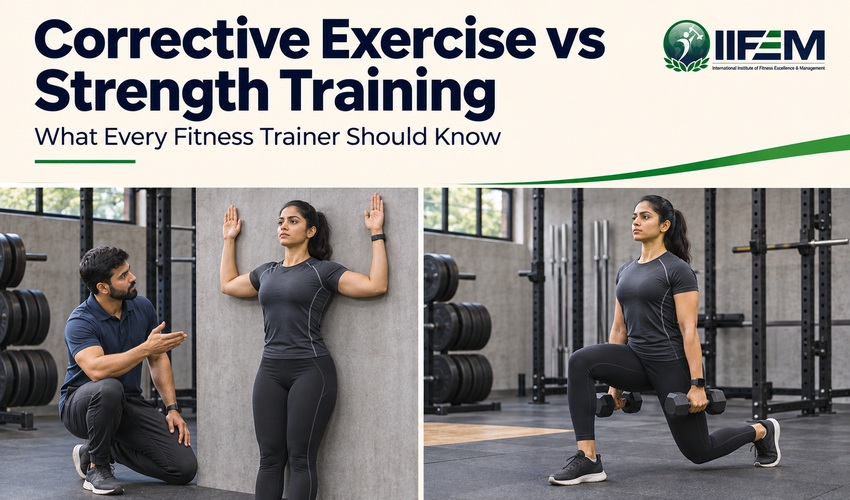
Corrective Exercise vs Strength Training: What Every Fitness Trainer Should Know
QUICK ANSWER: WHAT IS THE DIFFERENCE?
Corrective exercise aims to improve movement quality, joint function and muscle balance, while strength training aims to increase force, muscle size and overall physical capacity. Corrective exercise often comes first or runs alongside training to help clients move well. Strength training then builds on that foundation to make them stronger. The best trainers use both, guided by a proper movement assessment.
WHAT IS CORRECTIVE EXERCISE?
Corrective exercise is a structured approach that uses assessment and targeted drills to address movement limitations, such as restricted mobility, poor stability or inefficient movement patterns. It typically includes:
- Mobility drills to improve joint range of motion
- Activation and stability work for under-used muscles
- Movement pattern re-education, such as squat, hinge, push, pull and carry
- Breathing and posture strategies
- Gradual integration back into regular training
Important: corrective exercise is NOT medical treatment. Trainers should not diagnose or treat injuries. When a client has pain, a known condition or unusual symptoms, the correct step is referral to a doctor or physiotherapist.
WHAT IS STRENGTH TRAINING?
Strength training uses resistance, such as barbells, dumbbells, machines, bands or body weight, to challenge the muscles and stimulate adaptation. Its benefits are well supported by research and include:
- Greater muscular strength and power
- Increased muscle mass and bone density
- Improved metabolic health and body composition
- Better performance in daily life and sport
- Support for joint health when programmed sensibly
CORRECTIVE EXERCISE VS STRENGTH TRAINING: SIDE-BY-SIDE
Main goal
Corrective Exercise: Improve movement quality and control
Strength Training: Build strength, size and capacity
Typical intensity
Corrective Exercise: Low to moderate, controlled
Strength Training: Moderate to high, progressive
Starting point
Corrective Exercise: Movement assessment
Strength Training: Goal setting and strength testing
Common tools
Corrective Exercise: Mobility drills, activation, stability work
Strength Training: Barbells, dumbbells, machines, bodyweight
Best for
Corrective Exercise: Clients with limited movement or recurring discomfort (after medical clearance)
Strength Training: Most healthy clients and athletes
Progress marker
Corrective Exercise: Better range, control and pattern quality
Strength Training: Heavier loads, more reps, improved performance
DO YOU NEED TO CHOOSE? WHY THE ANSWER IS USUALLY NO
Many trainers see this as an either/or debate. In practice, the two work best together.
- Corrective exercise supports strength training. A client who cannot squat with good control will struggle to load the pattern safely.
- Strength training supports correction. Stronger muscles help stabilize joints and maintain better movement over time.
- The ratio changes by client. A beginner with stiff hips may need more corrective work. A trained lifter with minor limitations may need only a short warm-up block.
A simple session structure might look like this:
1. Assess and warm up (5 to 10 minutes): mobility and activation based on the client's needs
2. Main strength work (30 to 40 minutes): compound lifts and accessory exercises
3. Cool down (5 minutes): breathing and light mobility
HOW TO USE MOVEMENT ASSESSMENT AS A PERSONAL TRAINER
Good movement assessment for personal trainers removes guesswork. It helps you decide what to correct and what to simply train. A basic process includes:
1. Interview the client. Ask about injury history, pain, lifestyle, work posture and goals.
2. Observe posture and movement. Look at standing posture, overhead reach, squat, hip hinge, lunge and push-up patterns.
3. Identify patterns, not diagnoses. Note where movement looks limited or compensated, such as knees collapsing inward or the lower back overarching.
4. Prioritize. Pick one or two key issues instead of fixing everything at once.
5. Retest. Check improvement after a few weeks and adjust.
If an assessment reveals pain, numbness, swelling or a suspected injury, stop and refer the client to a qualified medical professional.
WHEN TO PRIORITIZE CORRECTIVE EXERCISE
- Clients with long desk hours and stiff hips or shoulders (once medically cleared)
- Beginners who cannot yet perform basic movement patterns well
- Lifters with recurring technique faults despite good coaching
- Clients returning to training after a break, with clearance from their healthcare provider
WHEN TO PRIORITIZE STRENGTH TRAINING
- Clients who move well and want to get stronger or build muscle
- Athletes needing power, speed and resilience
- Older adults looking to maintain independence, strength and bone health
- Anyone whose limitations are minor and can be managed in a warm-up
WHY GYM TRAINERS NEED CORRECTIVE EXERCISE SKILLS
With so many trainers entering the market, a specialist skill set helps you stand out. Corrective exercise for gym trainers can help you:
- Coach clients with common movement limitations more confidently
- Reduce avoidable setbacks by spotting problems early
- Build client trust through thoughtful, individual programming
- Know your scope and when to refer
- Offer a premium service and grow your income potential
BECOMING A CORRECTIVE EXERCISE SPECIALIST IN INDIA
A corrective exercise specialist certification gives you a structured framework for assessment, programming and professional boundaries. When choosing a corrective exercise course, look for:
- Clear coverage of anatomy, biomechanics and movement assessment
- Practical programming for mobility, stability and strength integration
- Guidance on scope of practice and referral
- Flexible online learning that fits your schedule
- Instructor support and an up-to-date syllabus
IIFEM (iifem.com) offers online fitness training certification courses across different verticals, so aspiring and working trainers can learn from anywhere in India. If you are searching for corrective exercise training in India or an advanced fitness trainer certification, visit iifem.com to check the latest course details, duration and enrolment options.
COMMON MISTAKES TRAINERS MAKE
- Over-correcting. Not every asymmetry is a problem. Fix what limits performance or comfort.
- Diagnosing. Trainers describe movement; they do not diagnose conditions.
- Neglecting strength. Endless mobility drills without loading will limit progress.
- Skipping retests. Without re-assessment, you cannot show improvement.
- Ignoring the client's goals. Corrective work should serve what the client wants to achieve.
FREQUENTLY ASKED QUESTIONS (FAQs)
Q: Is corrective exercise better than strength training?
A: Neither is better in every case. Corrective exercise improves movement quality, while strength training builds capacity. Most clients benefit from a combination, adjusted to their assessment results and goals.
Q: Can corrective exercise fix pain?
A: Corrective exercise may help some people move better and feel more comfortable, but it is not a medical treatment. Anyone with pain should consult a doctor or physiotherapist before starting a program.
Q: Can I do strength training with poor mobility?
A: Often yes, with sensible exercise selection and technique. For example, a client with limited ankle mobility might squat with a heel elevation or choose a different variation while working on mobility.
Q: Do I need a corrective exercise certification to train clients?
A: It is not always legally required, but a recognized certification helps you learn safe assessment methods, understand your scope and build credibility with clients and employers.
Q: How long does it take to complete a corrective exercise course?
A: Duration depends on the program and your prior knowledge. Check the course page on iifem.com for current details.
Q: Is corrective exercise only for people with injuries?
A: No. It can help anyone with movement limitations, but trainers should work within scope and refer injured clients to healthcare professionals.
FINAL THOUGHTS
Corrective exercise and strength training are partners, not rivals. Corrective work helps clients move well, and strength training helps them get stronger and more resilient. Trainers who understand both, and who know when to refer, deliver safer and more effective results.
Ready to upgrade your skills? Explore IIFEM's online fitness certification programs at iifem.com and take your coaching career to the next level.
Category
Recent Blog

Why is insulin neede... Read more
July 05,2023
10 Tips for Strength... Read more
August 14,2023
Sample Strength and ... Read more
September 06,2023
Why are some lifters... Read more
September 15,2023
Why do Barbells and ... Read more
September 22,2023
Secret Routine to Bu... Read more
September 26,2023
When to use Insulin,... Read more
September 28,2023
Why lifters should u... Read more
September 29,2023
What is power traini... Read more
October 09,2023
The Future of Fitnes... Read more
October 17,2023
Why Pursue a Fitness... Read more
October 21,2023
Career Paths for Cer... Read more
October 31,2023
Elevating Your Perso... Read more
November 21,2023
Gym Safety Correctiv... Read more
December 26,2023
5 Different Types of... Read more
December 27,2023
Elevate Your Fitness... Read more
December 28,2023
Embark on Your Fitne... Read more
January 24,2024
Mastering Nutrition ... Read more
January 24,2024
Building Strength wi... Read more
January 27,2024
Boost Your Career: B... Read more
January 27,2024
7 main reasons why y... Read more
February 15,2024
Unlocking Essential ... Read more
February 19,2024
Unlock Your Fitness ... Read more
February 20,2024
Unveiling the Path t... Read more
February 28,2024
How to choose the ri... Read more
February 29,2024
Strengthening Weak S... Read more
March 20,2024
How a Fat Loss and E... Read more
March 27,2024
Transformative Insig... Read more
March 27,2024
The Importance of a ... Read more
April 10,2024
Mastering the Art of... Read more
April 22,2024
Unlocking Your Caree... Read more
April 23,2024
The Evolution of Per... Read more
May 27,2024
Elevate Your Fitness... Read more
May 28,2024
Choosing the Right P... Read more
June 25,2024
Role of Protein in F... Read more
June 26,2024
Career Opportunities... Read more
June 27,2024
How Fitness Certific... Read more
July 29,2024
Building a Successfu... Read more
July 30,2024
Qualities to Look fo... Read more
August 21,2024
How Gym Trainer Cert... Read more
August 28,2024
How Fitness Trainer ... Read more
September 20,2024
The Role of a Person... Read more
September 23,2024
Immunity Boosting Pl... Read more
October 17,2024
How Fitness Trainers... Read more
October 22,2024
Transform Your Fitne... Read more
October 28,2024
Certified vs. Uncert... Read more
November 22,2024
The Role of Nutritio... Read more
November 25,2024
The Importance of Co... Read more
December 28,2024
5 Powerlifting Train... Read more
December 28,2024
How Personal Trainer... Read more
January 24,2025
Essential Online Nut... Read more
January 25,2025
How Personal Trainer... Read more
January 27,2025
5 Immunity-Boosting ... Read more
March 01,2025
What to Look for in ... Read more
March 01,2025
The Impact of a Pers... Read more
March 27,2025
The Benefits of Beco... Read more
March 28,2025
How to Choose the Ri... Read more
April 24,2025
Turbo Test: Unlockin... Read more
April 25,2025
How to Build a Perfe... Read more
April 29,2025
10 Powerful Yoga Asa... Read more
May 24,2025
How to Track Your Ca... Read more
May 26,2025
Fast-Track Your Fitn... Read more
May 28,2025
Top Career Paths You... Read more
May 29,2025
10 Reasons to Enroll... Read more
June 23,2025
How to Turn Your Pas... Read more
June 28,2025
Trainer vs Coach Wha... Read more
June 30,2025
How IIFEM Plans to C... Read more
July 01,2025
Go Global with IIFEM... Read more
July 11,2025
How to Avoid the Top... Read more
July 22,2025
No English No Proble... Read more
July 25,2025
How Education Can El... Read more
August 19,2025
Real Stories from II... Read more
August 20,2025
Why Gym Owners Prefe... Read more
August 26,2025
How Science Based Tr... Read more
August 31,2025
Why an International... Read more
September 10,2025
What Makes IIFEM the... Read more
September 15,2025
How to Build a Succe... Read more
September 22,2025
Your Passion and Our... Read more
September 27,2025
Fat Loss & Endurance... Read more
October 16,2025
Benefits of Whey Pro... Read more
October 21,2025
Strength and Conditi... Read more
October 27,2025
From Trainer to Gym ... Read more
October 29,2025
Powerlifting Trainin... Read more
November 12,2025
Pre-Workout vs Post-... Read more
November 17,2025
Building a Hybrid Fi... Read more
November 19,2025
Why Most Weight Loss... Read more
November 21,2025
Why Great Coaches Do... Read more
December 18,2025
Integrating Yoga for... Read more
December 18,2025
From Fitness Coach t... Read more
December 18,2025
Personal Trainers Sa... Read more
January 16,2026
Diploma in Fitness T... Read more
January 16,2026
Join Gym Training Co... Read more
February 10,2026
How to Become a Cert... Read more
February 10,2026
How a Certified Pers... Read more
February 18,2026
Turning Your Certifi... Read more
February 18,2026
Confused About Certi... Read more
March 14,2026
Turning Fitness Enth... Read more
March 14,2026
The Personal Trainer... Read more
March 14,2026
Building Authority i... Read more
March 18,2026
Top Fitness Skills E... Read more
April 10,2026
How IIFEM Certificat... Read more
April 15,2026
Thinking of Becoming... Read more
April 22,2026
Why Certified Fitnes... Read more
April 29,2026
Top 5 Gym Trainer Co... Read more
May 08,2026
Choose the Top Perso... Read more
May 15,2026
Become Top Physical ... Read more
May 16,2026
Online Diploma in Fi... Read more
May 21,2026
Best Gym Trainer Cer... Read more
June 10,2026
How to Become a Cert... Read more
June 08,2026
How to Become a Cert... Read more
June 11,2026
Top Career Opportuni... Read more
June 08,2026
Why the Fitness Indu... Read more
July 16,2026
How to Start Your Ca... Read more
July 18,2026
Why Online Certifica... Read more
July 26,2026
Want to Become a Cer... Read more
July 28,2026
Why Personal Trainer... Read more
August 10,2026
How to Choose the Ri... Read more
August 15,2026
What to Expect from ... Read more
August 25,2026
What Makes a Perfect... Read more
August 22,2026
How to Become a Cert... Read more
September 09,2026
Get Certified in Gym... Read more
September 11,2026
Certified Fitness Tr... Read more
September 16,2026
How to Design Workou... Read more
September 25,2026
Strength & Condition... Read more
October 05,2026Trainer to Master Tr... Read more
October 08,2026Diet Management Cour... Read more
October 11,2026
Corrective Exercise ... Read more
October 15,2026
Kettlebell Instructo... Read more
November 08,2026
Strength & Condition... Read more
November 11,2026
How to Become a Cert... Read more
November 15,2026