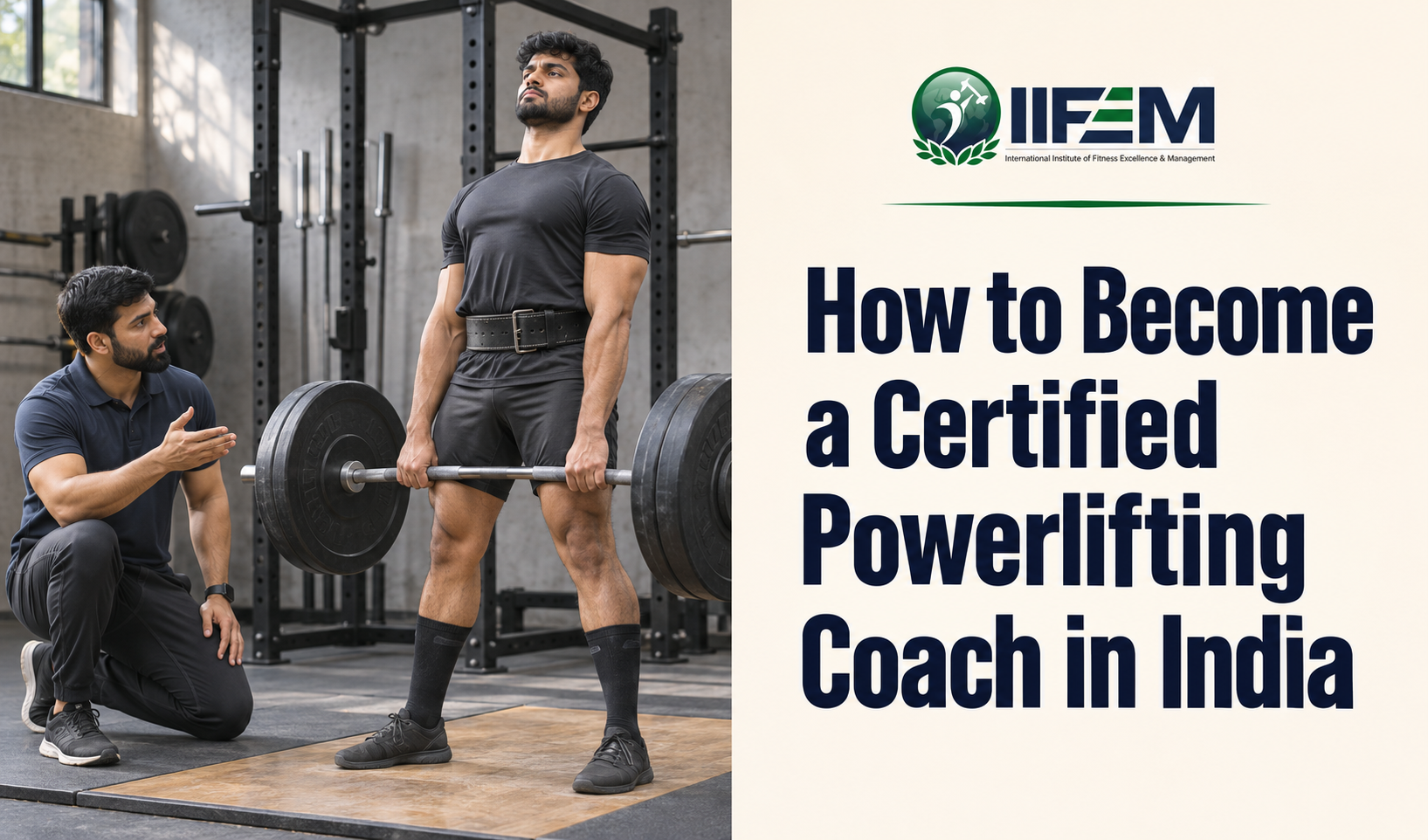
How to Become a Certified Powerlifting Coach in India
Quick Answer: How Do You Become a Powerlifting Coach in India?
To become a certified powerlifting coach in India, build your own lifting foundation, learn the science of strength training, complete a recognized powerlifting or strength coaching certification, gain supervised coaching experience, and keep learning. Online programs, such as those offered by IIFEM, let you study the theory and programming flexibly while you build practical experience in a gym or club near you.
The whole path can be broken into six steps, which this guide explains in detail.
Why Powerlifting Coaching Is a Growing Career in India
Powerlifting is a strength sport built around three lifts: the squat, bench press and deadlift. Athletes get three attempts at each, and the heaviest successful lifts are added into a total. It is simple to understand, measurable, and open to people of different ages, body types and backgrounds.
Interest in strength sports has been rising across Indian cities and smaller towns. More gyms run strength programs, more young people are entering competitions, and more families now see structured strength training as a path to health, discipline and sport. That creates demand for coaches who truly understand barbell training rather than just general fitness.
A qualified powerlifting coach can work in:
• Gyms and strength studios
• Powerlifting clubs and training academies
• Schools, colleges and sports institutions
• Online and one-to-one private coaching
• Fitness teams working with athletes from other sports who need a strength base
What Does a Powerlifting Coach Actually Do?
A powerlifting coach does much more than count reps. The role includes:
• Teaching technique for the squat, bench press and deadlift, and their variations
• Designing programs that progress load safely over weeks and months
• Assessing lifters for mobility, strength, injury history and goals
• Managing fatigue and recovery so athletes improve without burning out
• Preparing lifters for competition, including attempt selection, weight-class strategy and meet-day planning
• Building confidence, especially in beginners and young lifters
6 Steps to Become a Certified Powerlifting Coach in India
Step 1: Build Your Own Lifting Foundation
Great coaches usually understand the work from the inside. Train the three lifts consistently, learn what good technique feels like, and experience how progress and plateaus work. You do not need to be a champion, but you do need credible practical knowledge.
Step 2: Learn the Science Behind Strength
Strong coaching rests on knowledge, not opinion. Focus on:
• Basic anatomy and biomechanics of the squat, bench press and deadlift
• Progressive overload, volume, intensity and frequency
• Periodization models, such as linear and undulating approaches
• Warm-up design, mobility and injury prevention
• Sports nutrition and recovery fundamentals
Step 3: Choose a Powerlifting or Strength Coaching Certification
A powerlifting certification course or strength coaching certification gives your knowledge a structure and gives clients a reason to trust you. When comparing programs, check that they:
• Cover technique, programming, assessment and safety in depth
• Offer clear, up-to-date learning material
• Provide support from experienced instructors
• Fit your schedule, ideally with flexible online learning
• Clearly explain what the certificate does and does not qualify you to do
If you are searching for a powerlifting trainer course in India that you can complete online, explore IIFEM's certification programs at iifem.com and compare the current syllabus against your goals.
Step 4: Understand the Competitive Landscape
If you plan to coach competitive lifters, learn how meets work: weight classes, equipment rules, attempt selection, judging standards and anti-doping awareness. Powerlifting in India is organized through national and state-level federations. Check their latest rules, affiliations and coach or referee pathways directly, since requirements and recognition can change.
Step 5: Gain Practical Coaching Experience
Certification opens the door. Experience builds the career. You can:
• Assist a senior coach at a gym or club
• Coach friends and training partners using structured programs
• Volunteer with school or community fitness programs
• Record your coaching cues and programs, then review and improve them
• Document client results (with permission) to build your portfolio
Step 6: Keep Learning and Specialize
The best coaches never stop studying. After your foundation is solid, consider specializing in beginners, youth lifters, women's strength training, masters lifters, or competition prep. Update your knowledge with reputable research and coaching education.
Core Skills of a Powerlifting Training Specialist
Coaching the Squat, Bench Press and Deadlift
Good squat, bench press and deadlift coaching is built on fundamentals:
• Squat: bracing, bar position, depth, knee and hip tracking, and balance over mid-foot.
• Bench press: setup, shoulder position, leg drive, bar path and controlled touch.
• Deadlift: starting position, tension in the bar, lat engagement, hip hinge and lockout.
Always teach technique before adding load. Small cues, repeated well, usually beat long explanations.
Programming and Progression
Beginners often progress with simple, repeated practice and small load increases. Intermediate and advanced lifters need more planning, with varied intensity, managed volume and deliberate recovery. Strong programs stay flexible, because real life, sleep, stress and injuries affect training.
Safety and Communication
Teach lifters to use safeties, spotters and sensible warm-ups. Screen for pain, past injuries and health conditions, and refer athletes to medical professionals when something is outside your scope. Clear, respectful communication builds trust, especially with young or nervous lifters.
Powerlifting Coach vs. Personal Trainer vs. Strength and Conditioning Coach
|
Role |
Main Focus |
Typical Client |
|---|---|---|
|
Personal trainer |
General health, fat loss, fitness |
Everyday gym members |
|
Powerlifting coach |
Maximal strength in squat, bench and deadlift |
Lifters, competitors, strength enthusiasts |
|
Strength and conditioning coach |
Overall athletic performance across sports |
Athletes from various sports |
Many successful coaches combine these skills, which is why a broad strength training certification can be a smart starting point.
Career Paths After Powerlifting Coach Certification
With the right knowledge and experience, you can:
• Work as a strength coach in a gym or sports facility
• Start your own powerlifting club or training group
• Build an online coaching business
• Coach school and college athletes
• Work alongside other sport coaches to build strength programs
• Offer workshops and community training sessions
Earnings vary with experience, location, reputation and how you structure your services. Focus on delivering real results and building trust, because both lead to long-term growth.
How IIFEM Supports Youth and Aspiring Coaches
IIFEM (iifem.com) provides online fitness training certification courses across different verticals. Online learning removes many of the barriers that stop talented people from entering the fitness profession, such as distance, relocation costs and rigid class timings.
By making structured fitness education accessible, IIFEM aims to help:
• Young people build discipline, strength and a professional skill set early in life
• Aspiring trainers from smaller towns access quality learning without moving to a metro city
• Career changers and first-time earners step into a growing industry with a recognized learning path
• Women and people with limited access to traditional training institutes learn flexibly from home
Common Mistakes New Powerlifting Coaches Should Avoid
• Chasing heavy weights too early. Technique and consistency come first.
• Using one program for everyone. Individual needs, history and recovery differ.
• Ignoring warm-ups and accessory work. They support progress and joint health.
• Skipping communication. Lifters need to feel heard.
• Overstepping scope of practice. Refer medical, rehabilitation and nutrition issues to qualified professionals.
• Following trends without evidence. Choose methods that are supported by research and real coaching results.
Frequently Asked Questions (FAQs)
Is there a powerlifting coach certification in India?
Yes. Several organizations offer powerlifting-focused and strength coaching certifications in India, including online programs. Compare the syllabus, instructor support, assessment methods and recognition before enrolling, and visit iifem.com for current IIFEM course details.
Can I become a powerlifting coach online?
Yes, you can learn theory, program design, technique principles and coaching methods online. Pair that with hands-on experience in a gym or club so you can practice real-time coaching and technique correction.
Do I need to be a competitive powerlifter to coach powerlifting?
Not necessarily. Competitive experience helps you understand meets and lifter psychology, but strong knowledge, good coaching skills and practical experience matter most. Many effective coaches have never won a national title.
How long does it take to become a certified powerlifting coach?
The duration depends on the course and your background. Many certification programs can be completed in a few months, but becoming a confident coach takes ongoing practice. Check the course page on iifem.com for current duration details.
What is the difference between powerlifting and weightlifting?
Powerlifting consists of the squat, bench press and deadlift. Olympic weightlifting consists of the snatch and the clean and jerk. The two sports involve different techniques, speed demands and training methods.
Is powerlifting safe for teenagers?
When properly supervised and taught with correct technique, strength training is generally considered safe and beneficial for young people. Programs should be age-appropriate, focus on movement quality and avoid unnecessary maximal attempts for beginners.
How much can a powerlifting coach earn in India?
Income varies widely by experience, location, client base and business model. Coaches who build strong reputations, work with competitive athletes or run their own programs often have higher earning potential than entry-level trainers.
Final Thoughts
Becoming a certified powerlifting coach in India is a practical, rewarding path for anyone passionate about strength. Build your own foundation, learn the science, earn a credible certification, gain real coaching experience and never stop improving. Every great coach once started as a student of the barbell.
Ready to begin? Explore IIFEM's online fitness certification programs at iifem.com and take the first step toward coaching the next generation of strong, confident lifters.
Category
Recent Blog

Why is insulin neede... Read more
July 05,2023
10 Tips for Strength... Read more
August 14,2023
Sample Strength and ... Read more
September 06,2023
Why are some lifters... Read more
September 15,2023
Why do Barbells and ... Read more
September 22,2023
Secret Routine to Bu... Read more
September 26,2023
When to use Insulin,... Read more
September 28,2023
Why lifters should u... Read more
September 29,2023
What is power traini... Read more
October 09,2023
The Future of Fitnes... Read more
October 17,2023
Why Pursue a Fitness... Read more
October 21,2023
Career Paths for Cer... Read more
October 31,2023
Elevating Your Perso... Read more
November 21,2023
Gym Safety Correctiv... Read more
December 26,2023
5 Different Types of... Read more
December 27,2023
Elevate Your Fitness... Read more
December 28,2023
Embark on Your Fitne... Read more
January 24,2024
Mastering Nutrition ... Read more
January 24,2024
Building Strength wi... Read more
January 27,2024
Boost Your Career: B... Read more
January 27,2024
7 main reasons why y... Read more
February 15,2024
Unlocking Essential ... Read more
February 19,2024
Unlock Your Fitness ... Read more
February 20,2024
Unveiling the Path t... Read more
February 28,2024
How to choose the ri... Read more
February 29,2024
Strengthening Weak S... Read more
March 20,2024
How a Fat Loss and E... Read more
March 27,2024
Transformative Insig... Read more
March 27,2024
The Importance of a ... Read more
April 10,2024
Mastering the Art of... Read more
April 22,2024
Unlocking Your Caree... Read more
April 23,2024
The Evolution of Per... Read more
May 27,2024
Elevate Your Fitness... Read more
May 28,2024
Choosing the Right P... Read more
June 25,2024
Role of Protein in F... Read more
June 26,2024
Career Opportunities... Read more
June 27,2024
How Fitness Certific... Read more
July 29,2024
Building a Successfu... Read more
July 30,2024
Qualities to Look fo... Read more
August 21,2024
How Gym Trainer Cert... Read more
August 28,2024
How Fitness Trainer ... Read more
September 20,2024
The Role of a Person... Read more
September 23,2024
Immunity Boosting Pl... Read more
October 17,2024
How Fitness Trainers... Read more
October 22,2024
Transform Your Fitne... Read more
October 28,2024
Certified vs. Uncert... Read more
November 22,2024
The Role of Nutritio... Read more
November 25,2024
The Importance of Co... Read more
December 28,2024
5 Powerlifting Train... Read more
December 28,2024
How Personal Trainer... Read more
January 24,2025
Essential Online Nut... Read more
January 25,2025
How Personal Trainer... Read more
January 27,2025
5 Immunity-Boosting ... Read more
March 01,2025
What to Look for in ... Read more
March 01,2025
The Impact of a Pers... Read more
March 27,2025
The Benefits of Beco... Read more
March 28,2025
How to Choose the Ri... Read more
April 24,2025
Turbo Test: Unlockin... Read more
April 25,2025
How to Build a Perfe... Read more
April 29,2025
10 Powerful Yoga Asa... Read more
May 24,2025
How to Track Your Ca... Read more
May 26,2025
Fast-Track Your Fitn... Read more
May 28,2025
Top Career Paths You... Read more
May 29,2025
10 Reasons to Enroll... Read more
June 23,2025
How to Turn Your Pas... Read more
June 28,2025
Trainer vs Coach Wha... Read more
June 30,2025
How IIFEM Plans to C... Read more
July 01,2025
Go Global with IIFEM... Read more
July 11,2025
How to Avoid the Top... Read more
July 22,2025
No English No Proble... Read more
July 25,2025
How Education Can El... Read more
August 19,2025
Real Stories from II... Read more
August 20,2025
Why Gym Owners Prefe... Read more
August 26,2025
How Science Based Tr... Read more
August 31,2025
Why an International... Read more
September 10,2025
What Makes IIFEM the... Read more
September 15,2025
How to Build a Succe... Read more
September 22,2025
Your Passion and Our... Read more
September 27,2025
Fat Loss & Endurance... Read more
October 16,2025
Benefits of Whey Pro... Read more
October 21,2025
Strength and Conditi... Read more
October 27,2025
From Trainer to Gym ... Read more
October 29,2025
Powerlifting Trainin... Read more
November 12,2025
Pre-Workout vs Post-... Read more
November 17,2025
Building a Hybrid Fi... Read more
November 19,2025
Why Most Weight Loss... Read more
November 21,2025
Why Great Coaches Do... Read more
December 18,2025
Integrating Yoga for... Read more
December 18,2025
From Fitness Coach t... Read more
December 18,2025
Personal Trainers Sa... Read more
January 16,2026
Diploma in Fitness T... Read more
January 16,2026
Join Gym Training Co... Read more
February 10,2026
How to Become a Cert... Read more
February 10,2026
How a Certified Pers... Read more
February 18,2026
Turning Your Certifi... Read more
February 18,2026
Confused About Certi... Read more
March 14,2026
Turning Fitness Enth... Read more
March 14,2026
The Personal Trainer... Read more
March 14,2026
Building Authority i... Read more
March 18,2026
Top Fitness Skills E... Read more
April 10,2026
How IIFEM Certificat... Read more
April 15,2026
Thinking of Becoming... Read more
April 22,2026
Why Certified Fitnes... Read more
April 29,2026
Top 5 Gym Trainer Co... Read more
May 08,2026
Choose the Top Perso... Read more
May 15,2026
Become Top Physical ... Read more
May 16,2026
Online Diploma in Fi... Read more
May 21,2026
Best Gym Trainer Cer... Read more
June 10,2026
How to Become a Cert... Read more
June 08,2026
How to Become a Cert... Read more
June 11,2026
Top Career Opportuni... Read more
June 08,2026
Why the Fitness Indu... Read more
July 16,2026
How to Start Your Ca... Read more
July 18,2026
Why Online Certifica... Read more
July 26,2026
Want to Become a Cer... Read more
July 28,2026
Why Personal Trainer... Read more
August 10,2026
How to Choose the Ri... Read more
August 15,2026
What to Expect from ... Read more
August 25,2026
What Makes a Perfect... Read more
August 22,2026
How to Become a Cert... Read more
September 09,2026
Get Certified in Gym... Read more
September 11,2026
Certified Fitness Tr... Read more
September 16,2026
How to Design Workou... Read more
September 25,2026
Strength & Condition... Read more
October 05,2026Trainer to Master Tr... Read more
October 08,2026Diet Management Cour... Read more
October 11,2026
Corrective Exercise ... Read more
October 15,2026
Kettlebell Instructo... Read more
November 08,2026
Strength & Condition... Read more
November 11,2026
Corrective Exercise ... Read more
November 19,2026