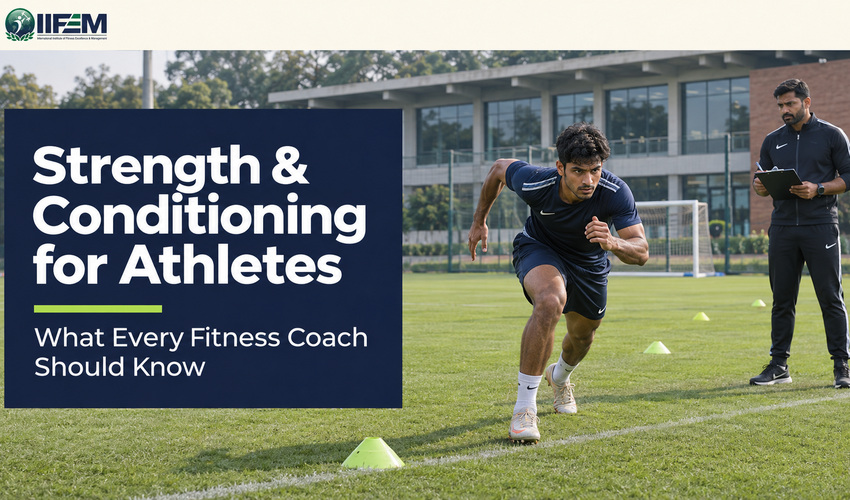
Strength & Conditioning for Athletes: What Every Fitness Coach Should Know
Quick Answer: What Is Strength and Conditioning for Athletes?
Strength and conditioning (S&C) is the science-based training of an athlete's strength, power, speed, endurance, mobility and resilience to improve sport performance and reduce injury risk. A good S&C coach does not simply make athletes tired. They assess the sport's demands, test the athlete, build a periodized plan, monitor recovery and adjust the program as the season changes.
If you are a fitness enthusiast who wants to turn your passion into a profession, understanding this discipline is one of the most valuable steps you can take.
Why Strength and Conditioning Matters in Modern Sport?
Athletes today compete in faster, more demanding environments than ever before. Skill and talent matter, but the athlete who is stronger, more explosive and better recovered has a clear advantage over a long season.
Sound strength and conditioning programs help athletes to:
- Produce more force and power, which supports sprinting, jumping, throwing and changing direction.
- Build work capacity, so they can maintain quality late in training sessions and matches.
- Lower injury risk by strengthening muscles, tendons and joints against the stresses of their sport.
- Recover faster between sessions and competitions.
- Extend their careers through smart load management.
For coaches, this means demand. Academies, clubs, schools, gyms and private athletes all look for trainers who understand sports performance training rather than generic gym workouts.
The Difference Between General Fitness and Athletic Training
Many new trainers make one common mistake: they train athletes like regular gym clients. The two are different in goals, structure and intensity.
|
Factor |
General Fitness |
Athletic Conditioning |
|---|---|---|
|
Main goal |
Health, fat loss, aesthetics |
Performance in a specific sport |
|
Programming |
Often goal- or preference-based |
Periodized around competition calendar |
|
Key qualities |
Strength, endurance, mobility |
Power, speed, agility, sport-specific endurance |
|
Monitoring |
Progress photos, body weight |
Performance tests, training load, readiness |
|
Risk management |
General injury prevention |
Sport-specific injury patterns and return-to-play |
7 Principles Every Strength and Conditioning Coach Should Know
1. Start with a Needs Analysis
Before writing a single set or rep, ask three questions:
- What does the sport demand? Consider energy systems, movement patterns, and common injuries. A sprinter, a cricket fast bowler and a footballer have very different needs.
- What does the athlete need? Assess training age, current strength, mobility, injury history and technical level.
- What is the timeline? Know the competition calendar, off-season length and available training days.
This step separates professional coaching from guesswork.
2. Apply Progressive Overload
Athletes adapt when they are exposed to gradually increasing demands. Progression can come from more load, more repetitions, better technique, shorter rest or higher speed. The key word is gradually. Sudden jumps in training load are a well-known contributor to overuse injuries.
3. Respect Specificity
The body adapts to what you train. A heavy squat builds general strength, but a sprinter also needs acceleration drills and a basketball player needs jump and landing mechanics. The best programs move from general foundations toward sport-specific qualities as competition approaches.
4. Use Periodization
Periodization means organizing training into planned phases so an athlete peaks at the right time. A simple yearly structure looks like this:
- Off-season: Build general strength, muscle mass, aerobic base and address weaknesses.
- Pre-season: Convert strength into power, speed and sport-specific conditioning.
- In-season: Maintain strength and power with lower volume while managing fatigue.
- Transition or active recovery: Rest, restore and rehabilitate.
Periodization prevents burnout and plateaus, and it gives you a clear reason behind every training decision.
5. Build Strength First, Then Power
Strength is the foundation of power. Athletes who are strong in basic patterns, such as squatting, hinging, pushing, pulling, and carrying, are better prepared for plyometrics, Olympic lift variations and sprint work. Teach technique before adding load, and load before adding speed.
6. Train the Energy Systems of the Sport
Conditioning should match the sport. A 100-metre sprinter relies on the phosphagen system, a footballer needs repeated high-intensity efforts with aerobic recovery, and a long-distance runner depends largely on aerobic capacity. Design intervals, work-to-rest ratios and drills accordingly.
7. Monitor, Recover and Adjust
Training only works if recovery keeps pace. Track simple indicators such as session RPE (rate of perceived exertion), sleep quality, soreness, jump performance and mood. Adjust the plan when the athlete is under-recovered. Good coaches treat data as a guide, not a rule.
Sample Weekly Structure for a Team-Sport Athlete (Pre-Season)
This is an illustrative template, not a one-size-fits-all prescription. Always individualize.
- Day 1: Lower-body strength + acceleration work
- Day 2: Upper-body strength + core stability
- Day 3: Active recovery, mobility, light aerobic work
- Day 4: Power (jumps, throws, Olympic lift variations) + change-of-direction drills
- Day 5: Full-body strength + sport-specific conditioning
- Day 6: Skill session or match
- Day 7: Rest
Common Mistakes New Strength and Conditioning Coaches Make
- Copying elite programs. What works for a professional athlete with years of training may injure a teenager.
- Ignoring mobility and movement quality. Strength built on poor movement is fragile.
- Overtraining. More is not better. Better is better.
- Skipping assessments. Without a baseline, you cannot show progress.
- Neglecting communication. Coaches must work with sport coaches, physiotherapists, parents and the athletes themselves.
- Forgetting youth considerations. Young athletes need technique, movement literacy and enjoyment before heavy specialization.
Skills and Knowledge You Need to Become a Strength and Conditioning Coach
To work confidently with athletes, a coach should develop competence in:
- Exercise science, anatomy and biomechanics
- Strength training technique and coaching cues
- Program design and periodization
- Speed, agility and plyometric training
- Energy system conditioning
- Athlete assessment and performance testing
- Injury prevention and basic return-to-training principles
- Sports nutrition fundamentals and recovery strategies
- Communication, ethics and professional practice
No single workout teaches all of this. It takes structured, quality education and hands-on practice.
Why Get Certified? The Value of a Strength and Conditioning Coach Certification
The fitness industry is open to everyone, which makes credibility a competitive advantage. A recognized strength and conditioning coach certification shows employers, clients and athletes that your knowledge is structured and up to date.
Certification can help you:
- Build trust with athletes, parents and sports institutions.
- Coach safely by understanding the science behind programming.
- Stand out in a crowded market of trainers.
- Open career paths in academies, gyms, schools, clubs, and private coaching.
- Charge with confidence for specialized services.
In India, the demand for strength training certification continues to grow as more people take up sport seriously, and as parents and institutions look for qualified coaches for young athletes.
Learn Strength and Conditioning Online with IIFEM
IIFEM (iifem.com) offers online fitness training certification courses across different verticals, designed for people who want to learn flexibly and build a real career in fitness.
If you are searching for a strength and conditioning course, an athletic conditioning course, or an online strength and conditioning course that fits around your schedule, an IIFEM program can help you:
- Learn the science of sports performance training in a structured, step-by-step way.
- Study from anywhere, at your own pace, without relocating.
- Understand how to design programs for athletes at different levels.
- Prepare for a professional role as a fitness or conditioning coach.
Visit iifem.com to explore the latest course details, syllabus, duration and enrolment options.
How to Start Your Journey as a Strength and Conditioning Coach
- Build your own foundation. Train consistently so you understand the work you will ask athletes to do.
- Learn the science. Enrol in a structured course that covers anatomy, programming, and athlete assessment.
- Get certified. Choose a credible certification that gives you a recognized qualification.
- Gain practical experience. Assist senior coaches, volunteer with school or club teams, and train friends in a structured way.
- Keep learning. Research and best practices evolve, so follow reputable journals and attend workshops.
- Specialize. Consider a niche such as youth athletes, cricket, football, combat sports or endurance sports.
Frequently Asked Questions (FAQs)
What does a strength and conditioning coach do?
A strength and conditioning coach designs and delivers training programs that improve an athlete's strength, power, speed, endurance and resilience. They assess athletes, monitor progress, manage training load and work alongside sport coaches and medical staff.
What is the difference between a personal trainer and a strength and conditioning coach?
A personal trainer usually focuses on general health, fitness and body composition goals. A strength and conditioning coach focuses on improving athletic performance in a specific sport, using periodized programs built around competition schedules.
Can I become a strength and conditioning coach online?
Yes. You can learn the theory, program design and assessment principles through an online strength and conditioning course. Combine online learning with practical coaching experience to build real-world skill.
Do I need a degree to become a strength and conditioning coach?
Requirements vary by employer and country. Some elite and university roles prefer degrees in sports science, while many gyms, academies and private coaching roles value a recognized certification plus practical experience.
How long does it take to become a certified strength and conditioning coach?
The time depends on your background and the program you choose. Some people complete a certification course in a few months, while building coaching experience is an ongoing process. Check the course page on iifem.com for current duration details.
Is strength training safe for young athletes?
When properly supervised and taught with correct technique, strength training is widely considered safe and beneficial for young athletes. Programs should be age-appropriate, focus on movement quality and avoid unnecessary maximal loading.
How much can a strength and conditioning coach earn in India?
Earnings vary widely based on experience, location, clientele and employer. Coaches working with academies, teams or high-level athletes and those who build a strong reputation generally have greater earning potential than entry-level trainers.
Final Thoughts
Strength and conditioning is where science meets sport. Coaches who understand needs analysis, progressive overload, specificity, periodization and recovery can help athletes perform better and stay healthier. If you are serious about this career, the best next step is to combine strong knowledge with credible certification and practical experience.
Ready to take the next step? Explore IIFEM's online fitness certification programs at iifem.com and start building the skills athletes and sports organizations look for.
Category
Recent Blog

Why is insulin neede... Read more
July 05,2023
10 Tips for Strength... Read more
August 14,2023
Sample Strength and ... Read more
September 06,2023
Why are some lifters... Read more
September 15,2023
Why do Barbells and ... Read more
September 22,2023
Secret Routine to Bu... Read more
September 26,2023
When to use Insulin,... Read more
September 28,2023
Why lifters should u... Read more
September 29,2023
What is power traini... Read more
October 09,2023
The Future of Fitnes... Read more
October 17,2023
Why Pursue a Fitness... Read more
October 21,2023
Career Paths for Cer... Read more
October 31,2023
Elevating Your Perso... Read more
November 21,2023
Gym Safety Correctiv... Read more
December 26,2023
5 Different Types of... Read more
December 27,2023
Elevate Your Fitness... Read more
December 28,2023
Embark on Your Fitne... Read more
January 24,2024
Mastering Nutrition ... Read more
January 24,2024
Building Strength wi... Read more
January 27,2024
Boost Your Career: B... Read more
January 27,2024
7 main reasons why y... Read more
February 15,2024
Unlocking Essential ... Read more
February 19,2024
Unlock Your Fitness ... Read more
February 20,2024
Unveiling the Path t... Read more
February 28,2024
How to choose the ri... Read more
February 29,2024
Strengthening Weak S... Read more
March 20,2024
How a Fat Loss and E... Read more
March 27,2024
Transformative Insig... Read more
March 27,2024
The Importance of a ... Read more
April 10,2024
Mastering the Art of... Read more
April 22,2024
Unlocking Your Caree... Read more
April 23,2024
The Evolution of Per... Read more
May 27,2024
Elevate Your Fitness... Read more
May 28,2024
Choosing the Right P... Read more
June 25,2024
Role of Protein in F... Read more
June 26,2024
Career Opportunities... Read more
June 27,2024
How Fitness Certific... Read more
July 29,2024
Building a Successfu... Read more
July 30,2024
Qualities to Look fo... Read more
August 21,2024
How Gym Trainer Cert... Read more
August 28,2024
How Fitness Trainer ... Read more
September 20,2024
The Role of a Person... Read more
September 23,2024
Immunity Boosting Pl... Read more
October 17,2024
How Fitness Trainers... Read more
October 22,2024
Transform Your Fitne... Read more
October 28,2024
Certified vs. Uncert... Read more
November 22,2024
The Role of Nutritio... Read more
November 25,2024
The Importance of Co... Read more
December 28,2024
5 Powerlifting Train... Read more
December 28,2024
How Personal Trainer... Read more
January 24,2025
Essential Online Nut... Read more
January 25,2025
How Personal Trainer... Read more
January 27,2025
5 Immunity-Boosting ... Read more
March 01,2025
What to Look for in ... Read more
March 01,2025
The Impact of a Pers... Read more
March 27,2025
The Benefits of Beco... Read more
March 28,2025
How to Choose the Ri... Read more
April 24,2025
Turbo Test: Unlockin... Read more
April 25,2025
How to Build a Perfe... Read more
April 29,2025
10 Powerful Yoga Asa... Read more
May 24,2025
How to Track Your Ca... Read more
May 26,2025
Fast-Track Your Fitn... Read more
May 28,2025
Top Career Paths You... Read more
May 29,2025
10 Reasons to Enroll... Read more
June 23,2025
How to Turn Your Pas... Read more
June 28,2025
Trainer vs Coach Wha... Read more
June 30,2025
How IIFEM Plans to C... Read more
July 01,2025
Go Global with IIFEM... Read more
July 11,2025
How to Avoid the Top... Read more
July 22,2025
No English No Proble... Read more
July 25,2025
How Education Can El... Read more
August 19,2025
Real Stories from II... Read more
August 20,2025
Why Gym Owners Prefe... Read more
August 26,2025
How Science Based Tr... Read more
August 31,2025
Why an International... Read more
September 10,2025
What Makes IIFEM the... Read more
September 15,2025
How to Build a Succe... Read more
September 22,2025
Your Passion and Our... Read more
September 27,2025
Fat Loss & Endurance... Read more
October 16,2025
Benefits of Whey Pro... Read more
October 21,2025
Strength and Conditi... Read more
October 27,2025
From Trainer to Gym ... Read more
October 29,2025
Powerlifting Trainin... Read more
November 12,2025
Pre-Workout vs Post-... Read more
November 17,2025
Building a Hybrid Fi... Read more
November 19,2025
Why Most Weight Loss... Read more
November 21,2025
Why Great Coaches Do... Read more
December 18,2025
Integrating Yoga for... Read more
December 18,2025
From Fitness Coach t... Read more
December 18,2025
Personal Trainers Sa... Read more
January 16,2026
Diploma in Fitness T... Read more
January 16,2026
Join Gym Training Co... Read more
February 10,2026
How to Become a Cert... Read more
February 10,2026
How a Certified Pers... Read more
February 18,2026
Turning Your Certifi... Read more
February 18,2026
Confused About Certi... Read more
March 14,2026
Turning Fitness Enth... Read more
March 14,2026
The Personal Trainer... Read more
March 14,2026
Building Authority i... Read more
March 18,2026
Top Fitness Skills E... Read more
April 10,2026
How IIFEM Certificat... Read more
April 15,2026
Thinking of Becoming... Read more
April 22,2026
Why Certified Fitnes... Read more
April 29,2026
Top 5 Gym Trainer Co... Read more
May 08,2026
Choose the Top Perso... Read more
May 15,2026
Become Top Physical ... Read more
May 16,2026
Online Diploma in Fi... Read more
May 21,2026
Best Gym Trainer Cer... Read more
June 10,2026
How to Become a Cert... Read more
June 08,2026
How to Become a Cert... Read more
June 11,2026
Top Career Opportuni... Read more
June 08,2026
Why the Fitness Indu... Read more
July 16,2026
How to Start Your Ca... Read more
July 18,2026
Why Online Certifica... Read more
July 26,2026
Want to Become a Cer... Read more
July 28,2026
Why Personal Trainer... Read more
August 10,2026
How to Choose the Ri... Read more
August 15,2026
What to Expect from ... Read more
August 25,2026
What Makes a Perfect... Read more
August 22,2026
How to Become a Cert... Read more
September 09,2026
Get Certified in Gym... Read more
September 11,2026
Certified Fitness Tr... Read more
September 16,2026
How to Design Workou... Read more
September 25,2026
Strength & Condition... Read more
October 05,2026Trainer to Master Tr... Read more
October 08,2026Diet Management Cour... Read more
October 11,2026
Corrective Exercise ... Read more
October 15,2026
Kettlebell Instructo... Read more
November 08,2026
How to Become a Cert... Read more
November 15,2026
Corrective Exercise ... Read more
November 19,2026